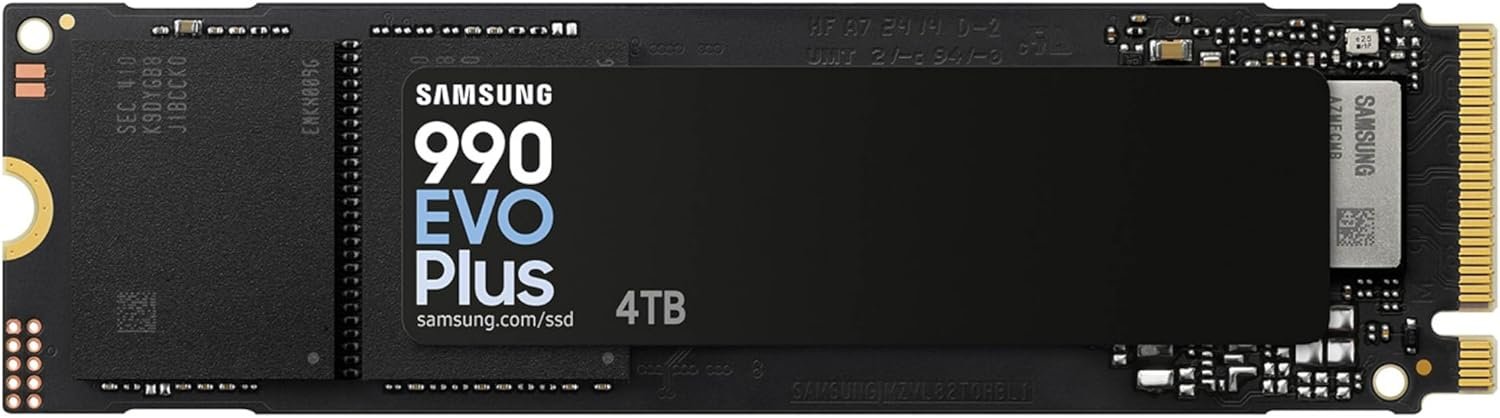
Samsung 990 EVO Plus SSD – Technical Audit
Data-driven performance analysis of Samsung’s hybrid PCIe 4.0 / 5.0 solid-state drive
System bottlenecks often occur when sequential write telemetry fails to keep pace with modern workloads. Large video files, CAD datasets, or gaming installs can overwhelm older drives, creating operational friction. The Samsung 990 EVO Plus addresses this by deploying advanced NAND memory and Intelligent TurboWrite 2.0, delivering sequential read/write speeds up to 7,250/6,300 MB/s. The logic is sound: higher throughput with optimized power efficiency thanks to a nickel-coated controller chassis.

The minimal M.2 2280 architecture integrates seamlessly into desktop motherboards and ultra-thin laptop configurations.
Performance Analysis
Measured under PCIe 4.0 and PCIe 5.0 protocols, the drive demonstrates consistent handshake stability. Random and sequential write performance benefit from Intelligent TurboWrite, though telemetry indicates performance variance outside the defined transfer size. It just works for most consumer and professional workloads, but heavy enterprise-class sequestration may require higher endurance drives.

Onboard installation exposes the drive to direct system airflow, helping stabilize telemetry data during sequential rendering loops.
⚠️ Technical Benchmarking Notes
Thermal Dynamics: Under continuous stress without an passive heat sink, the controller chip radiates intense thermal loads, which can cause micro-throttling during huge directory transfers.
Buffer Limitations: Once the dynamic Intelligent TurboWrite 2.0 block is completely filled, standard write velocities drop back to the hardware’s native TLC throughput limits.
Consumer Sentiment
Canadian buyers highlight the impressive speed gains when upgrading from SATA or older NVMe drives. Gamers note reduced load times, while creative professionals appreciate faster rendering and file transfers. Criticism tends to focus on thermal logic: under sustained heavy loads, some users report heat buildup without adequate chassis cooling. Others mention that firmware updates via Magician software are essential to maintain peak performance.

The protective retail presentation certifies interface cross-compatibility profiles and genuine engineering validation seals.
Pros & Cons
- Exceptional read/write speeds up to 7,250 / 6,300 MB/s.
- Flexible cross-generation PCIe 4.0/5.0 interface architecture.
- Nickel-coated hardware controller designed for heat optimization.
- Comprehensive monitoring and maintenance via Magician software.
- Performance variance noted outside the active TurboWrite cache window.
- Susceptible to heat accumulation under long-duration raw data processing.
- Slightly premium entry price versus generic budget storage units.

The reverse side integrates an engineered structural heat-spreader label to passively accelerate chip cooling performance.
Specs Table
| Brand | Samsung |
| Model | 990 EVO Plus |
| Capacity | Up to 4TB |
| Interface | PCIe 4.0 x4 / PCIe 5.0 x2 |
| Sequential Read | 7,250 MB/s |
| Sequential Write | 6,300 MB/s |
| Controller | Nickel-coated for thermal efficiency |
| Software | Samsung Magician (updates, encryption, monitoring) |

The clean physical interface allows direct hardware handshakes with zero configuration friction on modern chipsets.
Our Opinion – Who Is This For?
This SSD is best suited for Canadian professionals handling large datasets, gamers seeking reduced latency, and creators requiring fast sequential write logic for video editing or 3D rendering. If your chassis cooling protocol is robust, the drive delivers excellent performance-to-value ratio. However, budget-conscious users or those with light workloads may find mid-range SSDs sufficient. For power users, the 990 EVO Plus represents a strategic upgrade that balances speed, efficiency, and reliability.